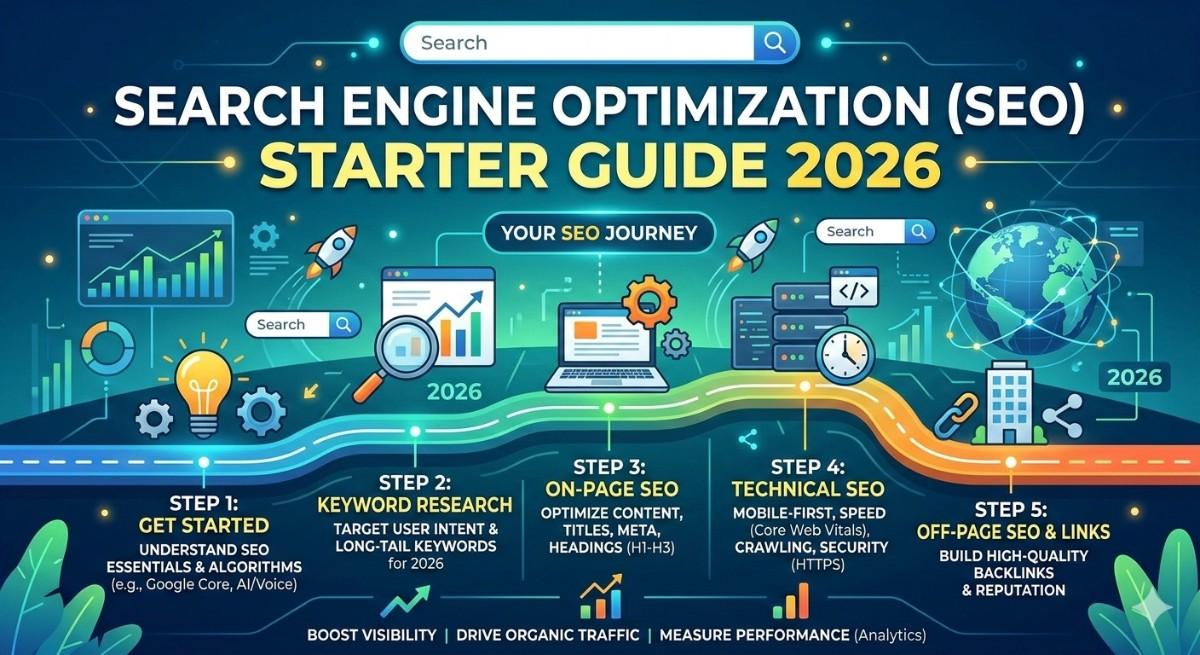
Search Engine Optimization (SEO) Starter Guide – Complete Guide for 2026
Search Engine Optimization (SEO) is the structured process of improving the visibility, relevance, and performance of websites in search engine results pages (SERPs). Its purpose is to increase high-quality organic traffic — users who are actively searching for information, products, or services — without relying solely on paid advertising.
SEO applies across multiple search formats, including web results, image search, video search, news listings, local map results, and increasingly AI-powered search interfaces. In 2026, SEO is no longer just about keywords. It integrates technical infrastructure, content strategy, authority signals, mobile optimization, and user behavior analysis.
Understanding SEO requires understanding how search engines function, how algorithms evolved, and how websites are evaluated today.
The Evolution of SEO
SEO began in the mid-1990s when early search engines indexed websites based largely on simple on-page signals such as keyword repetition and meta tags. Because ranking systems were relatively unsophisticated, manipulation was common.
The major shift occurred in 1998 when Google introduced PageRank, an algorithm that evaluated the authority of web pages based on inbound links. This innovation moved ranking systems beyond on-page elements and toward credibility assessment.
Over time, algorithm updates reshaped SEO standards:
| Update | Primary Focus | Impact on SEO |
|---|---|---|
| Panda (2011) | Content quality | Penalized thin & duplicate content |
| Penguin (2012) | Link spam | Reduced manipulative backlinks |
| Hummingbird (2013) | Semantic understanding | Improved query context matching |
| BERT (2019) | Natural language processing | Better intent interpretation |
| AI-driven updates (2025+) | Context & query expansion | Multi-layered search responses |
Today’s SEO landscape rewards relevance, depth, usability, and trust.
How Search Engines Work
Search engines operate through three primary stages: crawling, indexing, and ranking.
Crawling involves automated bots scanning the web to discover new and updated pages. These bots follow links to navigate from one page to another.
Indexing occurs when discovered pages are analyzed and stored in a searchable database. During indexing, search engines evaluate content, structure, metadata, and contextual signals.
Ranking determines which indexed pages appear first when a user submits a query. Algorithms evaluate hundreds of factors before ordering results.
The process can be summarized as:
| Stage | Function | Why It Matters |
|---|---|---|
| Crawling | Discover pages | Pages must be accessible |
| Indexing | Store content | Only indexed pages can rank |
| Ranking | Order results | Determines visibility |
If your website has technical issues that prevent crawling or indexing, strong content alone will not ensure rankings.
The Four Core Pillars of SEO
Modern SEO is built on four interconnected pillars.
1. On-Page SEO
On-page SEO focuses on optimizing elements within your website. This includes title tags, meta descriptions, structured headings, keyword alignment, internal linking, and content clarity. The goal is to help search engines understand the topic of each page while ensuring users find the information useful and readable.
2. Technical SEO
Technical SEO ensures the website’s infrastructure supports search visibility. Even high-quality content cannot perform well if technical barriers exist.
Important technical elements include:
- Fast page loading speed
- Mobile-first responsiveness
- Secure HTTPS connection
- Clean URL structures
- XML sitemaps
- Canonical tags
- Structured data markup
- Core Web Vitals optimization
Technical SEO forms the foundation upon which all other efforts depend.
3. Off-Page SEO
Off-page SEO strengthens authority through external signals. Backlinks from reputable websites act as endorsements that increase credibility.
Sustainable off-page strategies involve:
- Earning editorial backlinks
- Publishing authoritative content
- Digital public relations
- Brand mentions
- Industry collaborations
Search engines value natural authority over artificial link schemes.
4. Local SEO
Local SEO improves visibility in geographically targeted searches. As mobile searches dominate user behavior, local optimization has become increasingly important.
Key local ranking factors include:
- Google Business Profile optimization
- Consistent business information (NAP)
- Positive customer reviews
- Location-based keyword targeting
For service-based businesses, local SEO often drives the highest conversion rates.
Understanding Search Intent and Keyword Strategy
Effective SEO begins with understanding why users search.
Search queries typically fall into four categories:
| Intent Type | Example | User Goal |
|---|---|---|
| Informational | What is SEO | Learn |
| Navigational | Google Search Console login | Find a specific site |
| Commercial | Best SEO agency | Compare options |
| Transactional | SEO services near me | Take action |
Modern keyword strategy balances high-volume authority terms with long-tail, high-intent phrases. Long-tail keywords often convert better because they indicate clearer needs.
Rather than targeting isolated keywords, effective SEO builds topical clusters that demonstrate subject expertise across multiple related pages.
Technical Infrastructure and Indexing Control
Search engines rely on structured signals to understand website architecture.
Key indexing components include:
- XML sitemaps to guide discovery
- Robots.txt to control crawler access
- Canonical tags to prevent duplicate content
- 301 redirects to consolidate authority
- Internal linking to distribute page strength
Improper configuration may lead to crawl waste, diluted ranking signals, or indexing errors.
Mobile-first indexing further reinforces the importance of technical precision. Since most searches occur on mobile devices, search engines primarily evaluate mobile versions when ranking pages.
SEO vs Paid Advertising
SEO and paid search advertising serve complementary roles in digital marketing.
| Feature | SEO | Paid Advertising |
|---|---|---|
| Traffic Type | Organic | Paid |
| Speed | Gradual growth | Immediate visibility |
| Cost Model | No per-click cost | Pay per click |
| Longevity | Compounding | Stops when budget ends |
| Trust Perception | Higher | Moderate |
While paid campaigns provide immediate traffic, SEO builds sustainable long-term authority.
The Role of Content in SEO
Content remains central to search engine optimization. Search engines prioritize pages that demonstrate expertise, depth, and clarity.
High-performing SEO content typically:
- Addresses real user questions
- Provides structured explanations
- Demonstrates topical authority
- Uses semantic keyword relationships
- Encourages logical internal linking
Thin, duplicated, or low-value content rarely performs well in modern search environments.
Measuring SEO Performance
SEO success is evaluated through multiple performance indicators.
Core metrics include:
- Organic traffic growth
- Keyword ranking improvements
- Click-through rate (CTR)
- Engagement signals
- Conversion rate
- Backlink quality
Traffic alone does not guarantee success. Sustainable SEO focuses on attracting qualified users who take meaningful actions.
White Hat vs Manipulative SEO
SEO practices generally fall into two categories: ethical (white hat) and manipulative (black hat).
White hat SEO prioritizes long-term user value and adherence to search engine guidelines. Black hat tactics attempt to exploit algorithm weaknesses through deceptive techniques.
Risky practices include:
- Hidden text
- Cloaking
- Spam backlink schemes
- Keyword stuffing
- Automated link generation
Search engines continuously update algorithms to detect and penalize manipulative behavior.
The Future of SEO
AI-driven search systems are transforming how queries are interpreted. Rather than matching exact keywords, search engines now evaluate context, relationships between entities, and user behavior patterns.
Future-focused SEO emphasizes:
- Structured data implementation
- Semantic content clustering
- Authority and expertise signals
- Conversational search optimization
- AI-friendly formatting
SEO is shifting from optimizing individual pages to establishing domain-level expertise.
Why Choose AdsSpell for Professional SEO Services?
Understanding SEO is one thing — executing it strategically and consistently is another. Effective search engine optimization requires technical precision, data-driven keyword research, structured content strategy, and authority building that aligns with modern ranking systems. AdsSpell approaches SEO as a long-term growth framework, not a short-term ranking experiment. Every strategy is built around sustainable organic traffic, measurable performance metrics, and continuous optimization to adapt to algorithm updates. Whether your goal is higher search visibility, qualified lead generation, or long-term brand authority, AdsSpell focuses on results that compound over time rather than temporary spikes. SEO is not just about ranking pages — it’s about building digital dominance the right way.
Frequently Asked Questions About SEO
What is SEO in simple terms?
SEO is the process of improving a website so that it appears higher in unpaid search results when users search for relevant topics.
How long does SEO take to work?
Most websites begin seeing noticeable improvements within three to six months. Highly competitive industries may require longer timelines.
Is SEO better than Google Ads?
SEO provides long-term organic growth, while Google Ads offers immediate traffic. Both serve different strategic purposes and often work best together.
What are the most important SEO ranking factors?
Content relevance, backlink authority, page speed, mobile usability, secure HTTPS implementation, and structured data all influence rankings.
Can SEO guarantee first-page rankings?
No. Search engines constantly update their algorithms, and rankings depend on competition, authority, and content quality.
What is local SEO?
Local SEO optimizes a business’s visibility for geographically specific searches, often improving rankings in map results and “near me” queries.
Why is mobile optimization critical for SEO?
Search engines use mobile-first indexing, meaning the mobile version of a website is primarily evaluated when determining rankings.
Final Thoughts
Search Engine Optimization is a comprehensive and evolving discipline that integrates technical precision, content depth, authority building, and user experience design.
It is not a one-time tactic but a continuous strategic investment. When executed effectively, SEO builds sustainable visibility, attracts high-intent users, and strengthens digital credibility.
Organizations that treat SEO as long-term infrastructure rather than a short-term experiment position themselves for lasting online growth.
Read the previous blog – How to Grow a Business Online: Top 10 Proven Ways
Author Bio — Pranshu Soni
I’m Pranshu Soni, a digital marketer and founder of AdsSpell, a remote-first digital marketing agency helping businesses grow online across India and globally. I work with SEO, paid ads, analytics, and content systems that drive predictable growth instead of random results.
I’m passionate about numbers, strategy, gaming, bikes, and building scalable online businesses that work even when you’re offline.
Email: business@adsspell.com
Instagram: Adsspell.Marketing
Website: https://adsspell.com